Roof emergency? We respond fast across Merseyside Call 07596 884288

🏠 Warm Roof Specialists

Dormer Roof Warm Roof Upgrades

If your dormer roof suffers from condensation, mould or damp staining, the underlying cause is almost always cold-roof construction. We upgrade existing dormers to a Building Regulations Part L compliant warm roof specification — and unlike most roofers, every job is inspected and signed off by an independent Building Control inspector, not us.

✅ Independent Building Control sign-off ✅ 30+ years’ experience ✅ Written guarantee ✅ Free survey

Why cold-roof dormers cause condensation

Most dormer roofs built or converted before the last decade or so use what is called cold-roof construction: insulation is fitted between the rafters or ceiling joists, leaving the roof deck above it unheated. In principle this relies on a ventilated air gap between the insulation and the deck to keep the timber dry. In practice, that ventilation gap is very easy to compromise — insulation topped up over the years without proper detailing, gaps sealed for draught-proofing, or simply not enough gap specified in the first place.

Once ventilation is restricted, warm moist air from inside the room rises and reaches the cold underside of the roof deck. It condenses there, out of sight, above the ceiling. Over months and years this saturates the insulation — which stops working properly once wet — and begins to rot the structural timber. What you see from inside the room is usually the end result of a problem that has been building for a long time: mould in the corners of a sloped ceiling, brown staining following the line of the joists, or a persistent damp smell in the room.

A warm roof upgrade solves this at the source, rather than treating the symptoms. Insulation is moved above the roof deck, so the deck and structural timber stay warm and dry, with no cold surface inside the structure for moisture to condense against.

📋

Independent Building Control application & sign-off

🌡️

Part L compliant U-value specification

🛡️

10-year written guarantee

🔍

Full deck & structure inspection before quoting
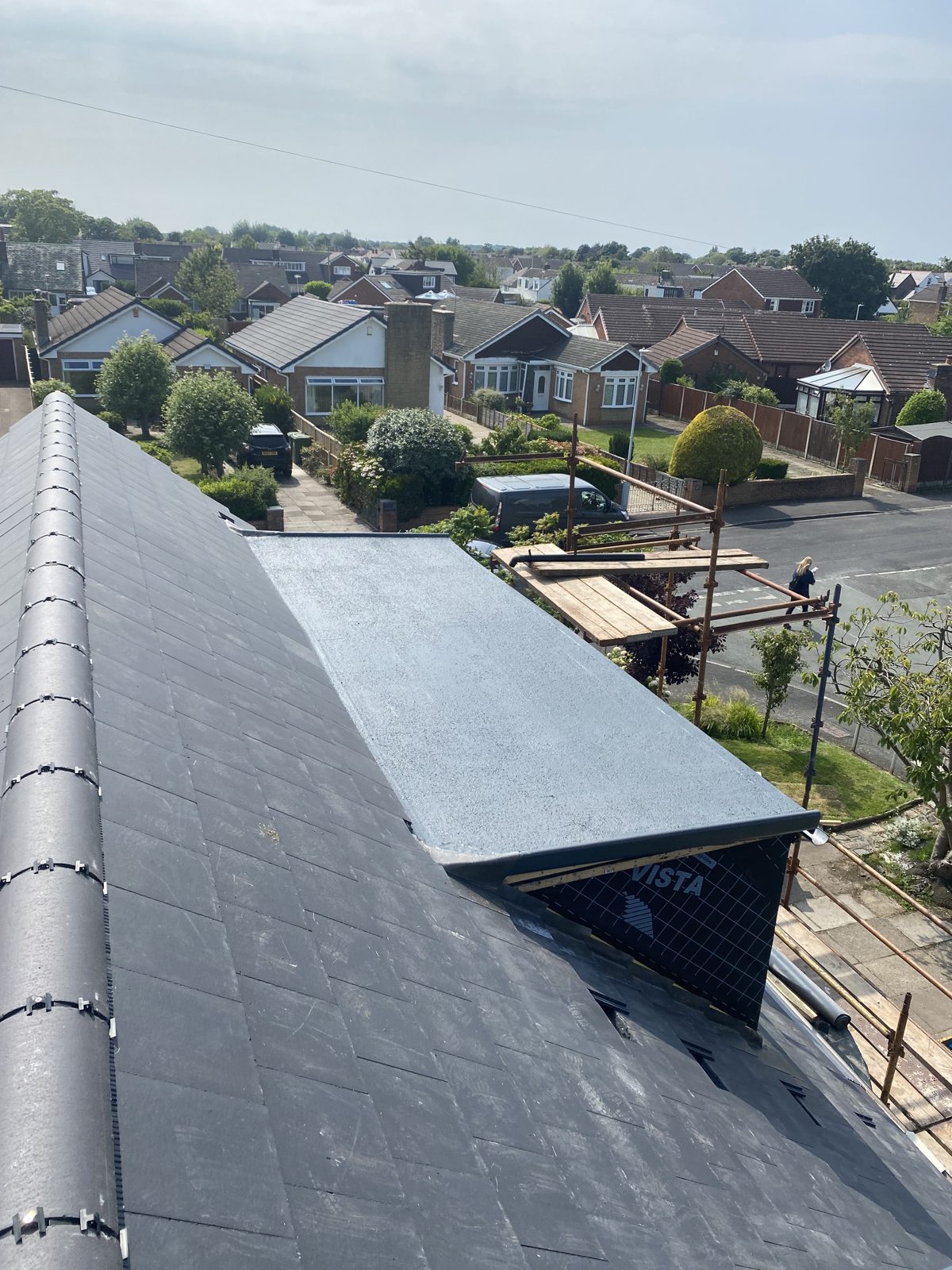
Completed dormer warm roof upgrade with GRP flat roof tie-in by Select Roofing Services
A recently completed dormer warm roof upgrade, GRP flat roof tied in below the ridge line.

Signs your dormer needs a warm roof upgrade

These are the signs we see most often on Merseyside surveys. One or two on their own don’t necessarily mean a major problem, but several together, especially in a room with a sloped dormer ceiling, point strongly towards cold-roof condensation.

Mould in ceiling corners

Black or grey speckled mould where the sloped ceiling meets the flat ceiling or side wall, often returning quickly after cleaning.

Staining along joist lines

Brown or yellow lines running parallel across the ceiling, following the position of the joists beneath the plaster.

Persistent damp smell

A musty smell in the room that doesn’t clear with ventilation, particularly noticeable when the room has been closed up.

Cold spots and condensation on windows

Noticeably colder patches on the sloped ceiling, or condensation forming on the inside of the dormer window even with heating on.

Read our full guide to dormer condensation & damp →

Is your dormer at risk?

Tick anything that applies to your dormer roof. This is a quick guide, not a survey — if more than one or two apply, it’s worth arranging a proper inspection.

What a warm roof upgrade involves

A warm roof upgrade means stripping back the existing roof covering, removing the old insulation and any damaged decking or timber, and rebuilding with insulation positioned above the structural deck rather than between the rafters or joists. A vapour control layer is fitted on the warm side of the insulation, beneath the deck, to stop moist air from the room reaching the insulation in the first place.

ElementTypical specification
Limiting U-value (Part L, existing dwellings)0.16 W/m²K for the upgraded roof area
Insulation thickness (rigid PIR, typical)150–200mm to meet the target U-value
Vapour control layerFitted continuously on the warm side, lapped and sealed at all joints
Thermal bridgingContinuous insulation across cheeks and roof, with thermal breaks at window reveals and metal flashings
Roof coveringGRP fibreglass, EPDM rubber or single-ply membrane over the new deck

The junctions are where warm roof upgrades succeed or fail — particularly where the dormer cheeks meet the roof, around the window reveal, and at the abutment with the main roof. Interrupted insulation or a missing vapour control layer at these points is the most common cause of a warm roof upgrade still suffering condensation afterwards. This is exactly the detailing our independent Building Control inspector checks at the appropriate stages, rather than us marking our own work.

Independent Building Control, on every job

Most roofers doing this kind of insulation upgrade either self-certify the work through a competent person scheme, or skip Building Control involvement altogether — leaving you with no paper trail if you come to sell the house, remortgage, or make an insurance claim later.

We do it differently. We use an independent Building Control inspector — not connected to us — on every dormer warm roof upgrade. They lodge the application with the local authority, inspect the work at the appropriate stages, and issue formal sign-off and a completion certificate once the job meets the required standard. It removes any conflict of interest and gives you a genuine, independent record of the work.

Read how our Building Control process works →

The upgrade process

1

Free survey & inspection

We inspect the existing dormer construction, assess the extent of any condensation damage, and confirm what a compliant warm roof upgrade will involve for your specific roof.

2

Written quote & Building Control application

You receive a fixed written quote. We lodge the Building Control application with the local authority and arrange the independent inspector before work starts.

3

Strip out & structural inspection

The existing covering, insulation and any damaged decking or timber are removed, exposing the structure for inspection. Any timber repair needed is agreed with you before proceeding.

4

Warm roof installation

New deck, vapour control layer, insulation to the required U-value, and the new waterproof covering are installed, with particular attention to the cheek and reveal junctions.

5

Independent inspection & sign-off

The Building Control inspector checks the completed work against the approved specification and issues formal sign-off.

6

Completion certificate

You receive your Building Control completion certificate — your permanent record of the work for resale, remortgage or insurance purposes.

What does a dormer warm roof upgrade cost?

Cost depends on the size of the dormer, the extent of the existing damage, the roof covering specified, and how much of the structural timber needs replacing once we can see behind the old covering. Because of this variation, we don’t publish a generic price for this particular upgrade — we survey first and give you a fixed written quote before any work begins, so you know exactly what you’re paying for and there are no surprises once the job is underway.

Free dormer roof survey across Merseyside

If your dormer roof shows signs of condensation or damp, call us on 07596 884288. We’ll inspect the roof, explain what’s causing it, and give you a fixed written quote for a warm roof upgrade with independent Building Control sign-off included.

📞 07596 884288 💬 WhatsApp

Dormer Roofs — What People Ask

What is the difference between a cold roof and a warm roof dormer? +

A cold roof dormer has insulation fitted between the rafters or joists, leaving the roof deck itself unheated and dependent on ventilation to stay dry. A warm roof dormer has insulation fitted above the deck, so the structure stays warm and dry with no cold surface for moist air to condense against. Warm roof construction is now the standard approach for dormer upgrades.

Why is my dormer roof getting condensation and mould? +

This is almost always a cold-roof construction issue. Warm, moist air from inside the house meets the cold underside of the roof deck and condenses there. Over time this saturates the insulation and structural timber, leading to mould, staining, and eventually timber decay. Blocked ventilation and poorly detailed insulation top-ups both make it worse.

Do I need Building Control approval to upgrade a dormer roof? +

Yes. Altering the insulation and structure of a roof, including a dormer, falls under the Building Regulations. We lodge a Building Control application with the local authority for every warm roof upgrade and use an independent inspector to approve and sign off the work, giving you a formal completion certificate.

Why do you use an independent Building Control inspector rather than self-certifying? +

Self-certification through a competent person scheme means the same company that did the work also signs it off, which is a conflict of interest even when the work is done properly. We use an independent inspector with no connection to us, so the approval is a genuinely impartial check carried out on your behalf.

How long does a dormer warm roof upgrade take? +

A typical single dormer upgrade takes three to five working days, including strip-out, structural inspection, insulation and covering installation, and weatherproofing. Building Control inspections are arranged at the appropriate stages and we schedule these in advance so they don’t add significant time to the job.

Condensation or damp staining on a dormer ceiling?

Free survey, honest advice, fixed written quote — and independent Building Control sign-off on every upgrade.

📞 Call 07596 884288 💬 WhatsApp Us
📞 💬