Of all the repair work we carry out across Merseyside, ridge re-bedding and pointing is the most common single job. It accounts for a significant proportion of our repair call-outs every year, across every type of pitched roof and every area we cover. Understanding what it is, why it fails and what the symptoms look like from the ground is genuinely useful for any homeowner in the north-west.
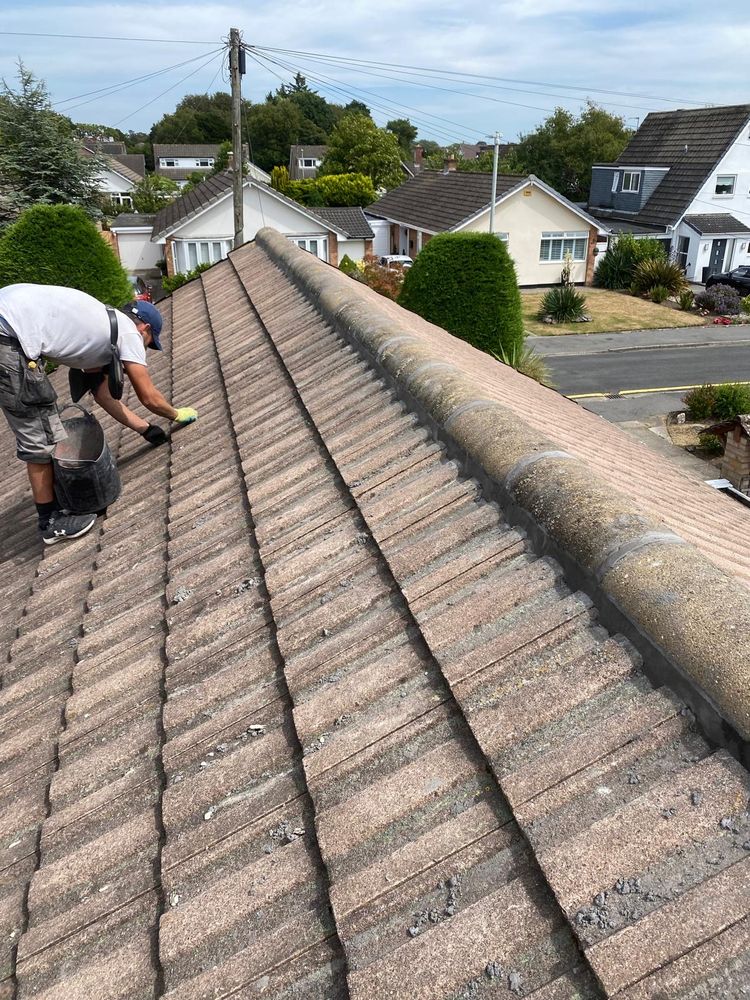
A recently completed job in Crosby — ridges removed, all old mortar stripped out, then re-bedded and re-pointed.
What is a ridge tile and how is it fixed?
The ridge tile is the curved or angled tile that runs along the apex of a pitched roof — the highest point where the two roof slopes meet. Hip tiles serve the same function on the diagonal angles where two roof planes intersect. Verge tiles finish the edge of a gable-end roof.
Unlike the main body of tiles or slates on a roof, which are fixed by nails or by hanging from battens, ridge and hip tiles are held in place by mortar. A bed of mortar is laid along the apex of the roof, the ridge tiles are pressed into it, and the joints between tiles are finished with more mortar — a process called pointing. When the mortar is fresh and sound, ridge tiles are secure and weathertight. When the mortar fails, they are held in place by nothing more than their own weight.
This is a design that has served roofs well for centuries and continues to do so when properly maintained. The problem is that mortar does not last forever, and on a roof that has not been checked for twenty or thirty years, the ridge mortar is almost certainly in need of attention.
Why ridge mortar fails
Ridge mortar at the apex of a roof is exposed to more weathering than almost any other element of the building. It faces full exposure to driving rain, frost, UV degradation and the physical stresses of thermal expansion and contraction — the constant movement caused by temperature changes between day and night and between seasons. Over time, this cycling causes the mortar to crack. Once cracking begins, water penetrates the crack, freezes and expands in winter, and the crack widens. This is the freeze-thaw cycle, and it is the primary mechanism by which ridge mortar on Merseyside roofs fails.
Salt air in coastal areas accelerates this process. In Southport, Hightown and Crosby, ridge mortar deteriorates faster than on equivalent properties inland. The combination of salt penetration and freeze-thaw action means maintenance intervals are shorter on coastal properties, and we see the evidence of this in the volume of ridge repair work we carry out in those areas relative to more sheltered locations.
The other significant cause of ridge mortar failure is the use of an incorrect mortar specification on previous repair work. Hard Portland cement mortar was widely used for ridge repairs through the 1970s and 80s. It is too rigid for this application — it does not accommodate the thermal movement that ridge tiles need to make, so it cracks faster than a more appropriate mix. We see the consequences of hard cement ridge work regularly, often within a few years of the previous repair.
What the symptoms look like from the ground
Cracked or crumbling mortar
If you can see the mortar joints on the ridge from the ground, look for cracking, gaps or sections that appear to have fallen away. Mortar debris in gutters is another sign — it comes from the ridge line above.
Ridge tiles that appear uneven
A sound ridge line should be straight and level. Any ridge tile that appears to have shifted, rotated or dropped below the line of its neighbours has moved and is no longer properly bedded.
Gaps between tiles
Visible gaps between ridge tiles — where you can see through to the roof surface below — indicate that mortar between the tiles has failed or been displaced.
Water ingress on the top floor
A damp patch on the ceiling of a top-floor room directly below the ridge, or water tracking down the inside of a chimney breast near the ridge, often indicates ridge failure as the entry point.
Mortar debris
Finding fragments of mortar in the gutters or on the ground below the roofline is a reliable sign that ridge or hip mortar is breaking down. It does not fall off unless it has failed.
Visible from the loft
In a loft with an open ridge — no underlay at the apex — failed ridge mortar sometimes allows daylight to be seen from inside. This is an unambiguous sign that re-bedding is overdue.
What re-bedding and pointing involves
Ridge re-bedding is carried out by accessing the roof from scaffold or ladder and working along the ridge line. The process involves removing each ridge tile individually, clearing the old mortar bed back to a sound surface, relaying a fresh bed of mortar of the correct specification and consistency, pressing the ridge tile back into position, and finishing the joints between tiles with pointing mortar.
The mortar specification matters. We use a mix that is appropriate for the specific roof covering and age of construction — a lime-modified sand and cement mortar that is softer and more flexible than straight Portland cement, allows appropriate thermal movement, and weathers correctly without premature cracking. On older or period properties we pay particular attention to this, as hard cement on Victorian or Edwardian construction causes more damage than it fixes.
Hip tiles and verge tiles are re-bedded using the same process. Where the ridge work is being carried out at the same time as other repairs — a common scenario, since ridge failure and other roofing issues often coincide — we address all of them in the same visit wherever possible.
Every ridge re-bed and pointing job we carry out is backed by our 10-year written guarantee. We use materials and methods we are confident enough to stand behind for a decade.
Ridge mortar issues across Merseyside
If you can see cracked mortar or uneven ridge tiles from the ground, or if you have found mortar debris in your gutters, call us on 07596 884288. We carry out a full inspection and provide a written quote before any work begins.
Related pages