Commercial Roofing
Commercial Roofing Explained
A commercial roof leak isn't just an inconvenience — it's stock damage, lost trading time, or an unhappy tenant. Commercial flat roofing uses the same GRP, EPDM and felt systems as domestic work, but non-domestic buildings carry a genuine, distinct fire classification requirement under Approved Document B that a domestic-only roofer might not fully understand. We focus on small to medium premises we can properly resource, and we're honest when a job needs a larger contractor.
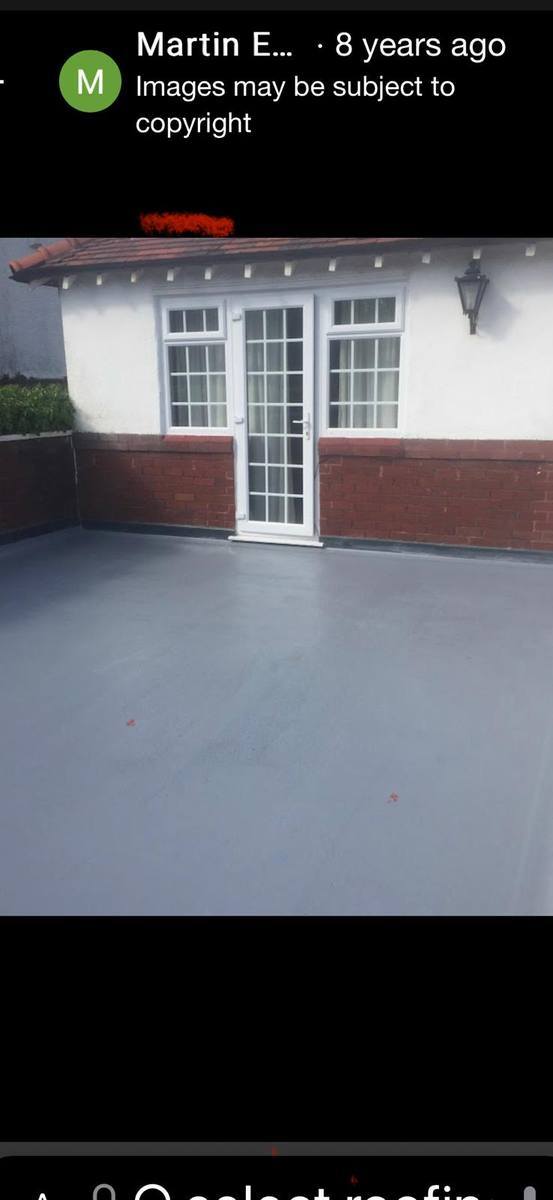
Commercial flat roofing — the material is familiar, the compliance requirement is genuinely different.
Commercial roofing gets treated as a bigger version of domestic work, and largely it is — but non-domestic buildings carry a distinct fire safety requirement that doesn't apply to houses, and it's easy for a roof covering to be specified without it. This guide covers what actually changes for a commercial roof, and what's worth asking any contractor before you commit.
On this page
Fire Classification — BROOF(t4)
Approved Document B, requirement B4 (external fire spread), sets out fire safety requirements for roof coverings on non-domestic buildings that simply don't apply to a house. Where a roof meets a fire compartment wall, the covering must be classified to BROOF(t4) under BS EN 13501-5:2016 for at least 1,500mm either side of the wall, on a substrate classified A2-s3,d2 or better.
This is a genuine, checkable requirement, not a technicality to skip. Worth asking any contractor quoting commercial work directly what classification their system achieves — if they can't answer, that's worth noting.
BROOF(t4) is the highest classification available and can be used unrestricted on any building; lower classifications (CROOF, DROOF and below) carry distance-from-boundary restrictions that depend on the building's use and position. We specify to BROOF(t4) as standard on commercial work, which removes the boundary-distance question entirely rather than leaving it to be worked out after the fact.
Being Honest About Job Scale
Most commercial roofing work we carry out is on small to medium premises — shops, offices, small warehouses and light industrial units. We work with business owners and landlords across Merseyside, using the same flat roof systems we install domestically — GRP fibreglass, EPDM rubber and high-performance torch-on felt — specified to suit the size, use and budget of the premises.
We're honest about scale. We focus on jobs we can properly resource and complete to the same standard as our domestic work, rather than stretching onto large industrial contracts we're not set up for. If your job is a better fit elsewhere, we'll tell you rather than take it on regardless.
Working Around Your Trading Hours
A closed shop or an office with no working roof over stock or equipment costs money every hour it's disrupted. Where genuinely needed, we can schedule work outside normal trading hours to minimise disruption — discussed as part of the survey, not assumed either way.
Documentation for Insurance & Landlords
Commercial roofing work often needs to satisfy more than just "is it fixed" — insurers, landlords and lease obligations frequently require proper documentation. We provide a written guarantee and completion paperwork suitable for insurance records or landlord requirements as standard, not as an add-on you have to request.
Planned Maintenance Contracts
For some premises, regular inspection genuinely reduces risk — catching a small issue before it becomes a trading disruption or an insurance claim. We advise honestly on whether your specific roof and use case warrants a planned maintenance contract or whether ad-hoc inspection is sufficient, rather than selling a contract by default.
Our Process
- Survey and scope honestly — we assess the job and tell you plainly if it's a better fit for a larger contractor.
- Specify to Approved Document B — roof covering classified correctly for the building's fire compartmentation requirements, not assumed.
- Work around your trading hours — scheduled to minimise disruption, including outside normal hours where genuinely needed.
- Install to specification — GRP, EPDM or felt installed to the correct fire classification and thermal standard.
- Documentation provided — written guarantee and completion paperwork suitable for insurance, landlord or lease purposes.
Commercial Roofing, Area by Area
We carry out commercial roofing across the whole of Merseyside and West Lancashire, with the same honest scoping and correctly-classified specification described on this page.
All Merseyside
Main commercial roofing page
Formby
Commercial roofing
Southport
Commercial roofing
Crosby
Commercial roofing
Hightown
Commercial roofing
Liverpool
Commercial roofing
Ormskirk
Commercial roofing
Maghull
Commercial roofing
Ainsdale
Commercial roofing
Birkdale
Commercial roofing
Bootle
Commercial roofing
Waterloo
Commercial roofing
Aintree
Commercial roofing
Blundellsands
Commercial roofing
Aughton
Commercial roofing
Lydiate
Commercial roofing
Kirkby
Commercial roofing
Litherland
Commercial roofing
Churchtown
Commercial roofing
Banks
Commercial roofing
Burscough
Commercial roofing
Crossens
Commercial roofing
Marshside
Commercial roofing
Thornton
Commercial roofing
Frequently Asked Questions
Summary
Commercial roofing uses familiar materials, but non-domestic buildings carry a genuine, distinct fire classification requirement that a domestic-only roofer might not fully apply. Ask any contractor quoting commercial work what BROOF(t4) means for your building, insist on documentation suitable for your insurer or landlord, and expect honesty about whether your job is genuinely the right fit for the size of contractor you're speaking to.
Commercial roof needing attention?
Correctly classified to Approved Document B, scheduled around your trading hours, proper documentation provided — anywhere across Merseyside.
Related guides
Flat Roofing Explained
The materials in full
Independent Building Control
How sign-off works on our jobs
Conservatory Roof Conversion
Same BROOF(t4) standard, domestic context
Professional Roof Survey Report
Documentation for landlords & insurers
Landlord & Portfolio Surveys
Multi-property assessment
Roofer Red Flags
What else to watch for in a quote