Leadwork
Leadwork Explained
Lead flashing is where most roof leaks actually start, and chimneys are where lead fails first — a genuine, well-established link between two of our specialisms. Correctly installed to BS 6915 with the right code for the detail and exposure, lead flashing lasts 60-100 years or more. Most premature failures trace back to the wrong code for the job or poor original detailing, not the material itself.
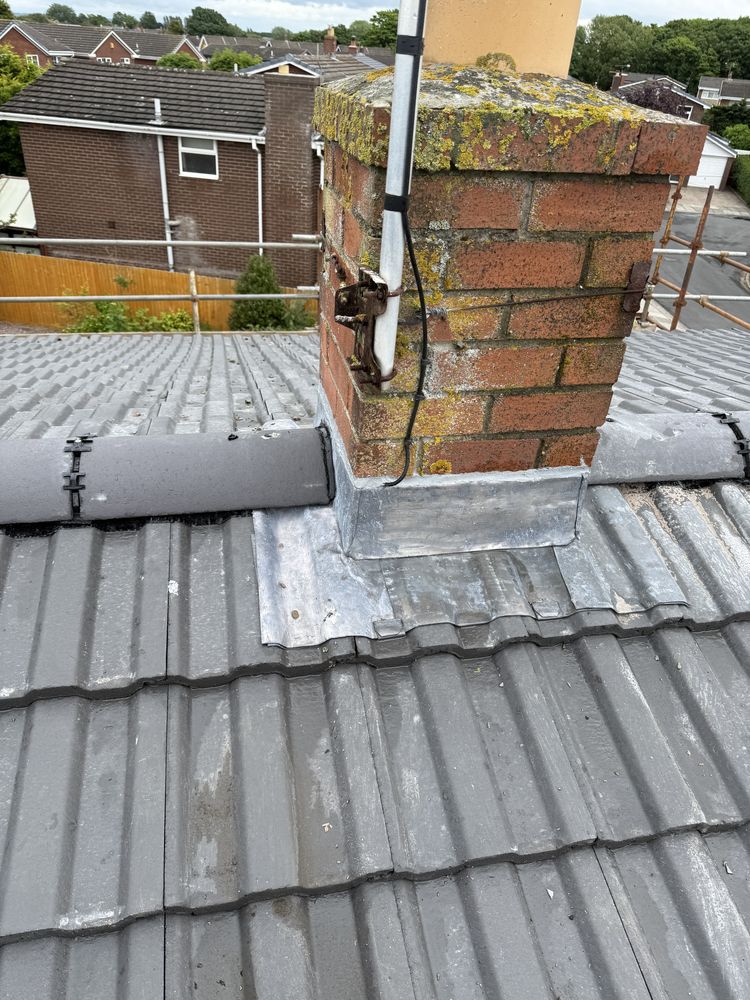
Lead chimney flashing — the most common leadwork job, and the most common failure point.
Leadwork gets less attention than tiles or slates, but it's arguably more important — every junction where a roof meets something else (a chimney, a wall, a valley, a dormer) depends on correctly specified and installed lead to stay watertight. This guide covers the British Standard that governs lead specification, why chimney flashing specifically fails so often, and what actually determines whether lead lasts decades or years.
On this page
Lead Codes Explained (BS 6915)
Rolled lead sheet manufacture is governed by BS EN 12588; installation and design is governed by BS 6915:2001+A1:2014, the British Standard that specifies bay sizes, joints, fixings and detailing for lead sheet roofing. Lead is supplied in numbered "codes" relating to thickness — getting the code right for the specific detail matters as much as the installation itself.
| Code | Thickness | Typical use |
|---|---|---|
| Code 3 | 1.32mm | Soakers, light/sheltered flashings — never valleys or gutters |
| Code 4 | 1.80mm | Standard chimney flashings, step and apron flashings, general abutments |
| Code 5 | 2.24mm | Valleys, wider flashings, more exposed locations |
| Code 6 | 2.65mm | Heavy-duty leadwork, parapet gutters, demanding exposure |
Code 4 is the most common specification for domestic chimney flashings and general use. The mistake to watch for isn't using lead at all — it's using too light a code for the exposure or the detail, which is a common cause of premature failure that has nothing to do with the material's genuine lifespan.
Why Chimney Flashing Fails First
Chimneys move slightly with weather, thermal cycling and age — more than most of the surrounding roof structure — and the lead flashing around the base has to accommodate that movement while staying completely watertight. This is a genuinely demanding detail to get right, which is exactly why it's also one of the most common places poor original work shows up years later.
The most common causes of premature chimney flashing failure: incorrect lead code specified for the exposure, sealant or mastic used instead of a properly dressed and fixed detail (a repair that looks fine for a year or two, then fails), and mechanical damage from previous chimney repointing work. See our chimney repairs guide for the full picture on chimney maintenance — leadwork and chimney condition are genuinely connected, and we assess both together on any chimney job.
Coastal Exposure & Code Selection
Coastal / exposed
- Higher wind loading
- Salt-laden air accelerates weathering
- Code 5 often more appropriate
- Applies to much of the Sefton coast
Sheltered / inland
- Lower wind exposure
- Code 4 usually sufficient
- Standard specification for most details
- Still needs correct BS 6915 detailing
Formby, Southport, Crosby, Hightown, Ainsdale, Birkdale and Waterloo all sit close enough to the Sefton coast that exposure genuinely affects the right specification — this isn't a universal upsell, it's a real consideration a competent leadworker should assess per property, not skip. We specify to the actual exposure of your specific roof, not a blanket default.
Lead Welding vs Alternatives
Lead welding fuses sections of lead sheet together into a single continuous piece using specialist equipment — a more skilled, slower process than soldering or mechanical jointing, but one that produces a genuinely seamless joint that handles thermal movement better over the long term. Soldered or mechanically jointed lead can still perform well when done correctly, but welding is the superior choice for complex or bespoke details where a long-lasting, watertight finish matters most.
Repair vs Replacement
Not every leadwork problem needs full replacement. Localised lifting or a small split, where the rest of the lead is sound, can often be re-dressed and re-fixed rather than stripped out entirely. Where the lead has genuinely reached the end of its serviceable life, or was undersized for the application from the original installation, replacement to the correct code is the honest recommendation — we'll tell you which applies rather than defaulting to the more expensive option.
Our Process
- Survey and diagnose — we identify the actual failure point, often not where the leak appears inside, and assess the existing lead code and condition.
- Specify the correct code — selected to BS 6915 for the specific detail and exposure, not a default thickness for every job.
- Strip and prepare — failed lead removed without damaging surrounding tiles, brickwork or stonework.
- Dress and fix — new lead cut, dressed and mechanically fixed to specification, welded rather than soldered where a seamless joint is needed.
- Inspect and guarantee — completed work checked and backed by our written guarantee.
Leadwork, Area by Area
We carry out leadwork across the whole of Merseyside and West Lancashire, with the same BS 6915-compliant, exposure-aware specification described on this page.
All Merseyside
Main leadwork page
Formby
Leadwork
Southport
Leadwork
Crosby
Leadwork
Hightown
Leadwork
Liverpool
Leadwork
Ormskirk
Leadwork
Maghull
Leadwork
Ainsdale
Leadwork
Birkdale
Leadwork
Bootle
Leadwork
Waterloo
Leadwork
Aintree
Leadwork
Blundellsands
Leadwork
Aughton
Leadwork
Lydiate
Leadwork
Kirkby
Leadwork
Litherland
Leadwork
Churchtown
Leadwork
Banks
Leadwork
Burscough
Leadwork
Crossens
Leadwork
Marshside
Leadwork
Thornton
Leadwork
Frequently Asked Questions
Summary
Leadwork is one of the least visible but most consequential parts of a roof — the material itself, correctly specified and installed to BS 6915, will genuinely outlast most of what's around it. The failures that show up as leaks almost always trace back to the wrong code for the job, poor original detailing, or a sealant-based shortcut rather than a proper dressed repair. Get those right, particularly around chimneys where movement and exposure matter most, and lead becomes the most durable part of the roof rather than the weak point.
Lead flashing failing or a chimney leak you can't trace?
BS 6915-compliant specification, correct code for your exposure, honest repair-vs-replace advice — anywhere across Merseyside.
Related guides
Chimney Repairs Explained
The other half of the chimney story
How a Roof Is Built
Where leadwork fits in construction
Independent Building Control
How sign-off works
New Roofs Explained
Materials for the wider roof
Flat Roofing Explained
Where flat and lead details meet
Roofer Red Flags
What else to watch for in a quote