New Roofs & Re-Roofing
New Roofs & Re-Roofing Explained
A new roof or re-roof is one of the biggest single investments you'll make in a property, and the two decisions that matter most are the material and who signs the work off. We fit concrete, clay and natural slate honestly specified to your property and budget — not upsold — and we arrange independent Building Control sign-off as standard, a genuinely separate inspection rather than the same company marking its own work.
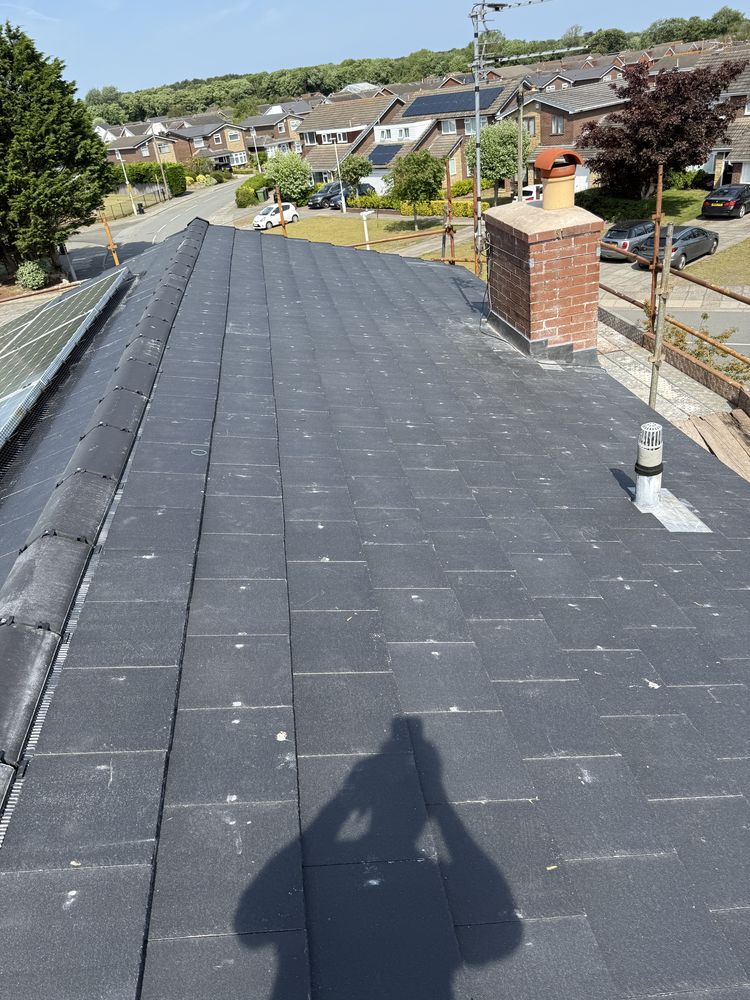
A completed re-roof — the material and the sign-off both matter to how long it lasts.
Few home improvements involve as much material and process choice as a new roof, and few get explained as poorly. This guide covers the tile and slate types available in the UK, what Building Regulations actually require, and the difference between self-certification and genuine independent sign-off — the things worth understanding before you compare quotes.
On this page
Re-Roof vs New Roof
These are generally the same job described two ways. A re-roof (or roof replacement) is an existing roof stripped back to the structure and covered with new materials. A genuinely new-build roof only applies to a property under construction. Most enquiries for "a new roof" are actually re-roofs on an existing home — worth knowing so you're comparing quotes for the same job.
Tile & Slate Types Compared
The right material depends on your property's age, style, structure and budget — there's no single "best" option, whatever a quote pushing one material might suggest.
Concrete Interlocking
40–60 years
The most cost-effective option and the standard choice for most modern properties. Heavier than clay, and colour fades over time, but genuinely good value and widely available.
Clay Tiles (Plain & Interlocking)
50–60+ years
Costs more than concrete but holds colour for the life of the tile rather than fading. Lighter than concrete. Well suited to period properties and coastal exposure.
Pantiles
40–60 years
Distinctive wavy profile, traditionally clay, now available in concrete too. Particularly associated with east-coast architecture but used across the UK.
Natural Slate
50–100+ years
The premium option. Non-combustible, distinctive finish, often required on listed buildings and conservation areas. Quality varies enormously by origin — see below.
| Concrete | Clay | Natural Slate | |
|---|---|---|---|
| Typical lifespan | 40–60 years | 50–60+ years | 50–100+ years (origin dependent) |
| Weight | Heaviest | Lighter than concrete | Heavy — structure must support it |
| Colour retention | Fades over time | Holds colour for life | Natural finish, doesn't fade |
| Typical cost | Lowest | Mid-range | Highest, varies hugely by origin |
| Best suited to | Most modern properties | Period & coastal properties | Period, listed & conservation-area properties |
Not All Slate Is Equal
This matters more than most homeowners realise, and it's worth understanding before you accept a quote that just says "slate roof" without specifying which.
UK Slate (Welsh / Cumbrian)
- 80–100+ year lifespan
- The benchmark for quality worldwide
- Often required on listed buildings
- Highest upfront cost, lowest lifecycle cost
Lower-grade imports
- Quality varies hugely by source
- Can delaminate or crack prematurely
- Grading and provenance often unstated
- Cheaper upfront, can cost more over time
Spanish slate, properly graded, sits in between — typically achieving around 50 years, a genuine mid-range option when sourced and specified correctly. The point isn't that imported slate is automatically bad; it's that quality varies enormously and a roofer should specify thickness, grading and provenance rather than just saying "slate" on a quote. We always do.
Building Regs & Independent Sign-Off
By law, replacing 50% or more of a roof covering must be notified for Building Regulations compliance — failure to do so can result in prosecution and a significant fine. There are two legitimate routes to compliance:
- Self-certification — the roofer is registered with the NFRC CompetentRoofer scheme and self-certifies their own work as compliant. This is legal, common, and used by many reputable roofers — it's a genuine government-backed scheme, not a shortcut.
- Independent Building Control — a separate Local Authority or approved inspector reviews and signs off the completed work, entirely independent of the company that did it.
We use the second route as standard on every qualifying job. Self-certification is legitimate, but it means the same company checking its own work. Independent sign-off means someone with no stake in the job confirms it's compliant — a genuinely stronger form of assurance, and the certificate matters when you come to sell, since it shows up on a solicitor's local authority search. See our dedicated guide to independent Building Control sign-off for the full process.
Our Process
- Inspect and specify — we assess the existing roof, structure and your property, and specify the right material honestly, not the one that's easiest to sell.
- Notify Building Control — independent notification arranged as standard for qualifying work, not self-certification alone.
- Strip and inspect — the old covering removed and the structure, battens and timber inspected before anything new goes on.
- Install to specification — underlay, battens and the chosen tile or slate installed to BS 5534 fixing standards, with correct ventilation.
- Independent sign-off and guarantee — an independent inspector signs off the completed work, and you receive a written guarantee.
For a realistic sense of cost, see our new roof cost guide.
New Roofs, Area by Area
We install new roofs and carry out re-roofing across the whole of Merseyside and West Lancashire, with the same honest, materials-first approach described on this page.
All Merseyside
Main new roofs page
Formby
New roofs
Southport
New roofs
Crosby
New roofs
Hightown
New roofs
Liverpool
New roofs
Ormskirk
New roofs
Maghull
New roofs
Ainsdale
New roofs
Birkdale
New roofs
Bootle
New roofs
Waterloo
New roofs
Aintree
New roofs
Blundellsands
New roofs
Aughton
New roofs
Lydiate
New roofs
Kirkby
New roofs
Litherland
New roofs
Churchtown
New roofs
Banks
New roofs
Burscough
New roofs
Crossens
New roofs
Marshside
New roofs
Thornton
New roofs
Frequently Asked Questions
Summary
A new roof is a decades-long decision, and the two things worth understanding before you compare quotes are the material and who checks the work. Concrete, clay and slate all have a genuine place depending on your property — the honest answer is rarely "always choose the most expensive one." And when it comes to sign-off, self-certification is legal and common, but independent Building Control is a genuinely stronger form of assurance. We specify materials honestly and use independent sign-off as standard, not as an upsell.
Considering a new roof or re-roof?
Honest material specification, independent Building Control sign-off, written guarantee — anywhere across Merseyside.