Bungalow Roofing Guide
Is My Bungalow Roof Pitch Too Low for Its Tiles?
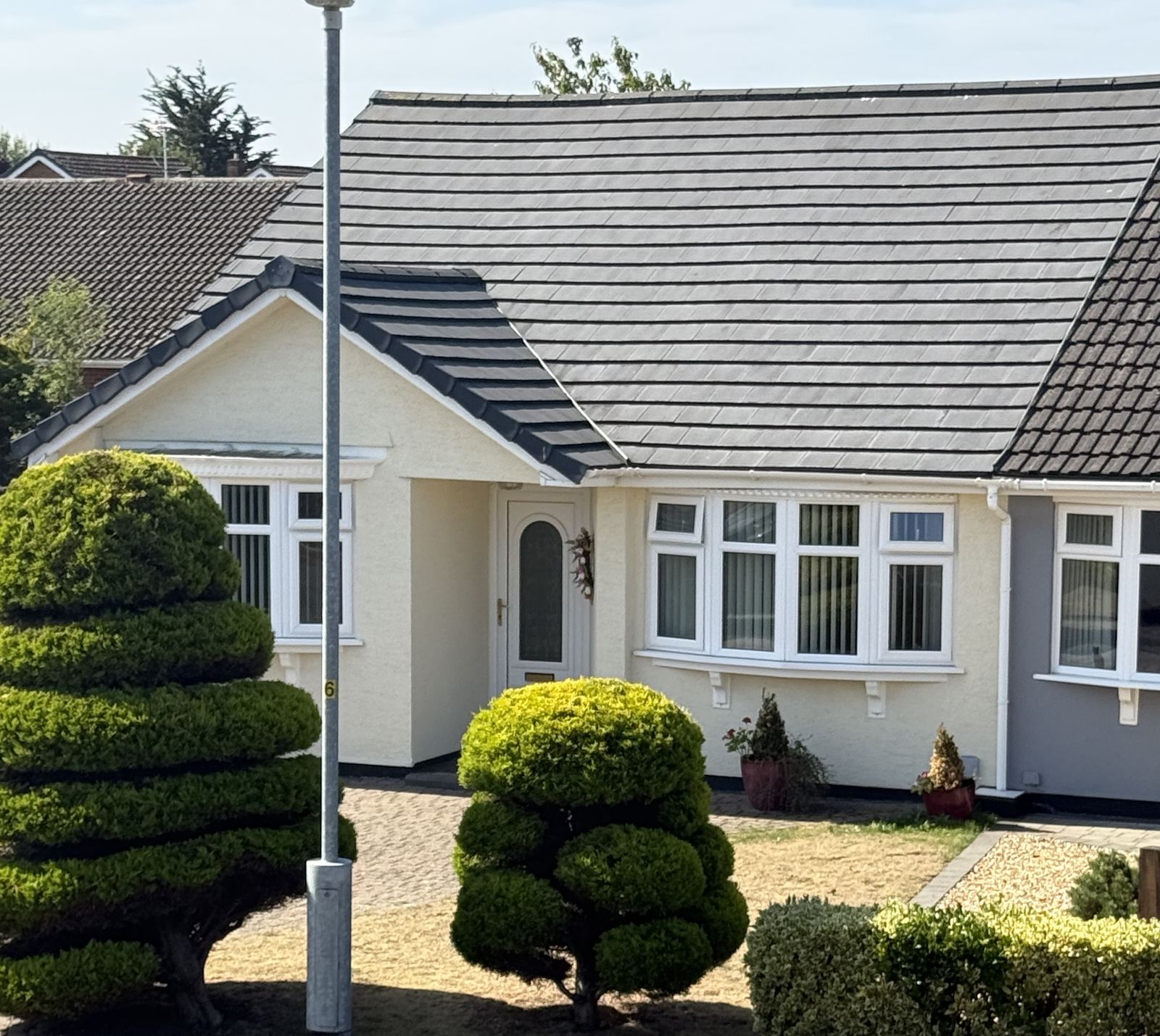
If you own a bungalow built between about 1955 and 1980 in Maghull, Lydiate, Formby, Ainsdale, Southport or Aughton, there is a fair chance the tiles on your roof were never rated for the angle they sit at. It is one of the most common defects a buyer’s surveyor flags on a Merseyside bungalow, it is almost never explained properly, and it is the reason a roof that “looks fine” leaks in a westerly.
Every tile has a minimum pitch
A tiled roof keeps water out by gravity and overlap. Water runs down the tile, over the lap onto the tile below, and off the eaves. That works as long as the roof is steep enough for water to move faster than wind can push it back up, and for the lap to be longer than water can climb by capillary action. Below a certain angle, it stops working.
The British Standard for slating and tiling, BS 5534, has historically treated 20 degrees as the floor for slates and tiles, and every manufacturer publishes a minimum pitch for each product. For the large concrete interlocking tiles used on most Merseyside bungalows the figure is typically 22.5 degrees, with a few profiles rated to 17.5 and a small number of modern products lower still. Go below the rated pitch and the manufacturer’s guarantee is void and the roof will let water in.
Why bungalows are the problem
Bungalows were built low for a reason: a low pitch uses less timber and fewer tiles, keeps the ridge below the planning height and lets the house sit quietly in its plot. The 1960s and 70s estates across Sefton were routinely designed at 17 to 22 degrees. The builder then bought whatever concrete tile was cheapest and available that month, and nobody checked the datasheet. Six bungalows on the same close, all with the same pitch and the same tile, all with the same problem — that pattern is common enough that we recognise the estates by name.
How to check your own roof
- Measure the pitch. A smartphone spirit-level app held flat against a rafter in the loft, or against a tile from a ladder, gives a reading within a degree. Between 17 and 22 is the danger zone.
- Identify the tile. Most concrete interlocking tiles have the manufacturer’s name cast on the underside. Redland, Marley and Sandtoft profiles all have published minimum pitches; a spare tile in the garage or a photo of the underside from the loft is enough for us to check.
- Look at the underlay. If the roof has been below pitch for decades, the underlay has been doing the roof’s job. Brittle, torn or stained felt in the loft is the tell-tale.
- Check the pattern of leaks. Below-pitch roofs leak in driving rain from one direction and stay dry in a downpour on a still day. That is diagnostic.
What it means if the answer is yes
It does not mean the roof will fall in, and it does not always mean a new roof tomorrow. It means the roof is depending on the underlay, and the underlay has a life. Once it has gone, patching tiles does nothing because the tiles were never the waterproof layer.
The honest options, in order of cost:
- Manage it. If the underlay is still sound, keep the roof clear of moss, keep ridges and verges tight, and plan for a re-roof in the medium term. We say this to a lot of customers.
- Re-roof with a low-pitch tile. At re-roof, specify a tile rated for your actual pitch. Several modern interlocking tiles are rated to 15 degrees and some lower, on a sealed-lap or upgraded underlay system. This is the correct fix and it is what we do on every below-pitch bungalow we re-roof. Our bungalow re-roof pages cover it town by town.
- Sealed underlay system. Where the pitch is only just below the tile’s limit, a fully taped, high-performance underlay laid to the manufacturer’s low-pitch specification can bring the roof within tolerance without changing the tile.
- Roof-over. For roofs well below 15 degrees, a sheet or membrane roof beneath a decorative tile finish. Rare on a bungalow, but it exists.
Buying or selling a bungalow
Surveyors do pick this up, and buyers use it. If you are buying, ask the surveyor to record the pitch and identify the tile, and get a roofer to price the correct fix before you exchange. If you are selling, know the answer before the buyer’s surveyor does — a below-pitch roof reported by your own roofer with a sensible quote attached is a very different negotiation from one discovered on the other side.
Questions we get asked
What is the minimum pitch for concrete roof tiles?
It depends on the tile. Most large-format concrete interlocking tiles are rated to 22.5 degrees; some profiles go to 17.5 and a few modern low-pitch products to 15 or below on a sealed underlay system. The manufacturer datasheet is the authority. BS 5534 has historically treated 20 degrees as the general floor for tiles and slates.
My bungalow is at 18 degrees. Is that a problem?
It depends entirely on which tile is on it. At 18 degrees a tile rated to 22.5 is below pitch and relying on the underlay; a tile rated to 17.5 is within tolerance if laid correctly. We identify the tile and measure the pitch at the free inspection.
Can you fix a below-pitch roof without a full re-roof?
Sometimes. If the pitch is only marginally below the tile’s limit and the underlay is sound, an upgraded, fully sealed underlay to the manufacturer’s low-pitch specification can bring the roof into tolerance. If the underlay has perished, the fix is a re-roof with a tile rated for the pitch.
Will the roof fail Building Control?
A roof already in place is not inspected retrospectively. But when a roof is re-covered, the new covering must be suitable for the pitch, and Building Control will expect the tile specification to match. That is one reason a below-pitch bungalow should be re-roofed with the right tile rather than like-for-like.
Not sure what your roof needs?
We offer free inspections across Merseyside. We go up, take photos, show you what we find and give you an honest recommendation. No pressure, no obligation.