Flat Roofing
Flat Roofing Explained
Flat roofing is one of the most misunderstood parts of a property. EPDM and GRP both comfortably outlast traditional felt — 50 years plus against roughly 15 — and modern Building Regulations mean almost every full replacement is also a genuine opportunity to properly insulate the roof, often for the first time. We install and repair all three systems, specify the right one honestly rather than the one that's easiest to sell, and bring every replacement up to current warm roof standards as a matter of course.
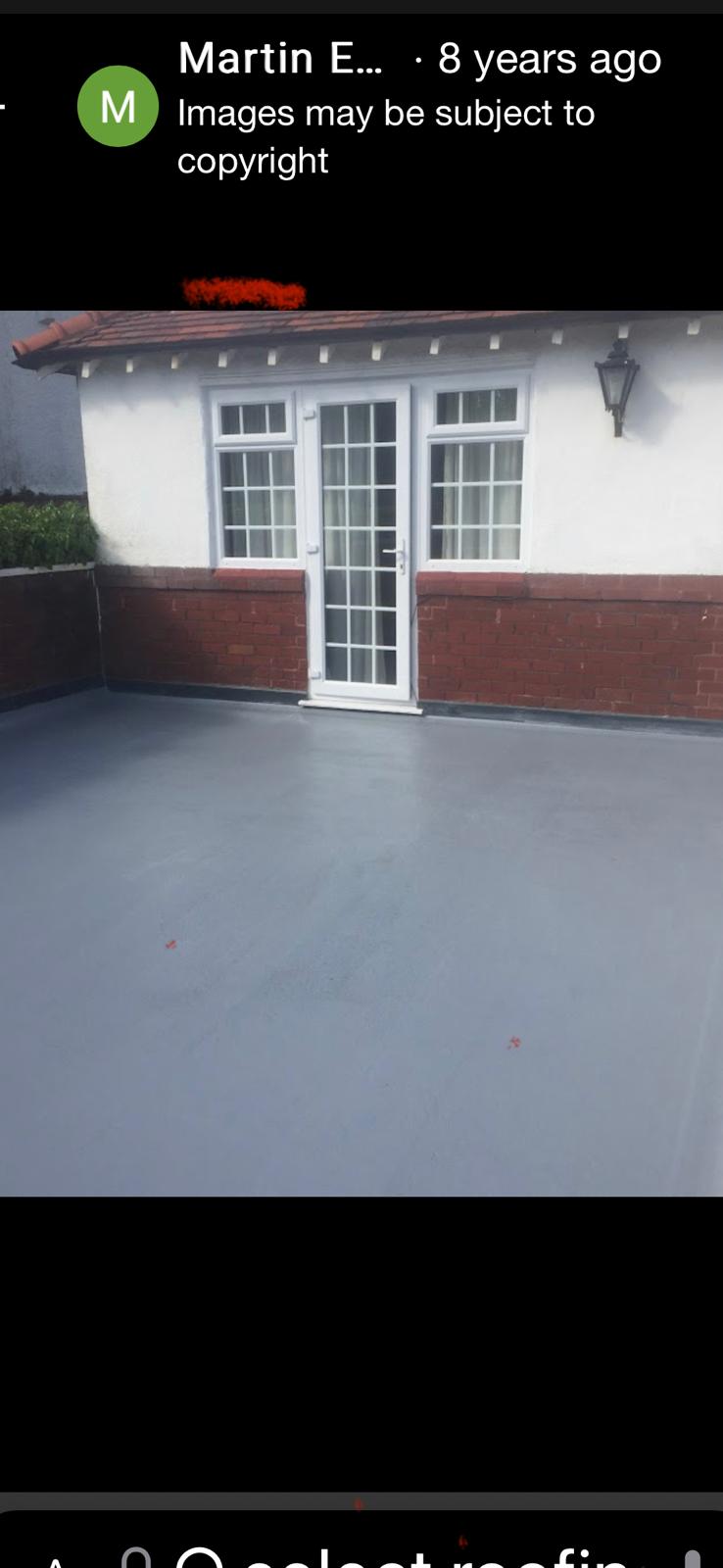
GRP fibreglass flat roof — one of three systems we specify depending on the roof.
Flat roofs get a bad reputation, and most of it traces back to one material: traditional felt, installed decades ago, now failing the way felt eventually always does. Modern flat roofing systems are genuinely different — properly specified and installed, a flat roof can outlast a pitched one's covering. This guide covers the materials, the Building Regulations that apply to any full replacement, and how to tell whether your roof needs a repair or a replacement.
On this page
EPDM vs GRP vs Felt
Three materials cover almost every flat roof in the UK, and they are genuinely not interchangeable. For the full comparison including installation method and edge cases, see our dedicated materials guide — the summary here is enough to have an informed conversation with any contractor.
EPDM Rubber
50–60 years
Flexible, single membrane with no joints on most domestic roofs. Handles thermal movement well and is straightforward to repair — punctures and tears are usually fixable without stripping the roof.
GRP Fibreglass
50–60 years
Rigid, seamless once cured. Well suited to roofs used as walkways or with foot traffic. Correct installation matters more than with EPDM — a poorly installed GRP roof fails much sooner.
Traditional Felt
~15 years
The cheapest option upfront, with joints and seals that expand and contract with temperature and eventually fail. Still has a place on lower-budget or short-term projects — not on anything meant to last.
| EPDM | GRP | Felt | |
|---|---|---|---|
| Typical lifespan | 50–60 years | 50–60 years | ~15 years |
| Joints | None (single membrane) | None (seamless once cured) | Multiple, sealed with heat |
| Repairability | Straightforward, localised | Possible, more involved | Common, but often recurring |
| Best suited to | Most domestic roofs, large spans | Walkways, high foot traffic | Lower-budget or short-term projects |
| Installation sensitivity | Moderate | High — installer skill matters | Moderate |
Building Regulations & U-values
Current Approved Document L (Conservation of Fuel and Power) targets a flat roof U-value of around 0.16–0.18 W/m²K — sources cite slightly different figures depending on whether the work is new construction or a renovation, and we specify to whichever applies to your project rather than assuming. A full replacement covering more than 50% of the roof typically triggers this requirement as a "thermal element" upgrade, the same threshold that applies to pitched roof re-covers.
In practice this means: if your flat roof is being fully replaced, current regulations expect it to be properly insulated to modern standards, not simply re-covered with the same thin, decades-old insulation underneath. Achieving the target typically needs 130–160mm of PIR insulation, or more with less efficient materials. We build every full replacement to this standard as a matter of course, not as an optional extra.
Warm Roof Upgrades
Warm roof (recommended)
- Insulation sits above the structural deck
- Deck stays close to room temperature
- Condensation risk largely eliminated
- Full insulation depth counts toward U-value
Cold roof (not recommended)
- Insulation sits between the joists
- Requires a 50mm ventilation gap
- Meaningfully higher condensation risk
- Harder to hit current U-value targets
Warm roof construction is now the standard, recommended approach for any new or fully replaced flat roof — a cold roof build-up isn't recommended for new work under current guidance. If your existing flat roof is a cold roof reaching the end of its life, replacement is a genuine opportunity to convert to warm roof construction and correct a design that was never ideal in the first place, often for a modest difference in cost against simply re-covering like-for-like.
Repair vs Replacement
Not every flat roof problem needs a full replacement, and we'll tell you honestly which applies to yours.
- EPDM roofs — punctures, tears and failed edge seams are usually repairable without stripping the whole roof, using compatible repair tape and adhesives. Most repairs are completed in hours.
- GRP roofs — cracks and localised damage can often be repaired, though a poorly installed original roof may have problems beyond a single patch.
- Felt roofs — repairable, but felt nearing the end of its natural lifespan tends to develop new failures shortly after old ones are fixed. At that point, replacement is usually the better long-term value even though the repair is cheaper today.
See our guides on signs a flat roof needs replacing and flat roof condensation and damp for more detail on diagnosing the specific problem you're seeing.
Emergency Flat Roof Repairs
Flat roofs can fail suddenly — a split membrane after a storm, standing water finding a weak point, or a puncture that's let water track a long way before it's noticed. When that happens, stopping water ingress quickly matters more than a perfect permanent fix on day one. We respond quickly to genuine flat roof emergencies across Merseyside with a temporary weatherproof solution, followed by a proper assessment and permanent repair or replacement once the roof can be looked at properly.
Our Process
- Survey and specify — we assess the deck, current insulation and the right system for the roof's size, use and exposure, not a default material.
- Strip and inspect — the old covering is removed and the deck inspected for rot or damage before anything new goes down.
- Insulate to current Building Regs — warm roof insulation installed to meet current U-value targets, a genuine opportunity that doesn't come round again for decades.
- Install the membrane — GRP, EPDM or felt applied to manufacturer specification, with correct falls, upstands and edge trims.
- Final inspection and guarantee — every installation checked before we leave and backed by a written guarantee.
Flat Roofing, Area by Area
We install and repair flat roofs across the whole of Merseyside and West Lancashire, with the same honest, materials-first approach described on this page.
All Merseyside
Main flat roofing page
Formby
Flat roofs
Southport
Flat roofs
Crosby
Flat roofs
Hightown
Flat roofs
Liverpool
Flat roofs
Ormskirk
Flat roofs
Maghull
Flat roofs
Ainsdale
Flat roofs
Birkdale
Flat roofs
Bootle
Flat roofs
Waterloo
Flat roofs
Aintree
Flat roofs
Blundellsands
Flat roofs
Aughton
Flat roofs
Lydiate
Flat roofs
Kirkby
Flat roofs
Litherland
Flat roofs
Churchtown
Flat roofs
Banks
Flat roofs
Burscough
Flat roofs
Crossens
Flat roofs
Marshside
Flat roofs
Thornton
Flat roofs
Frequently Asked Questions
Summary
Flat roofing has a reputation problem it doesn't fully deserve — mostly earned by decades-old felt reaching the end of a lifespan it was always going to have. Modern systems, properly specified and installed to current Building Regulations, are a genuinely long-term solution. The two decisions that matter most are the material — matched honestly to your roof, not the easiest sell — and whether a full replacement is used as the opportunity it is to finally insulate the roof properly. Get those two things right and a flat roof stops being the maintenance headache its reputation suggests.
Flat roof needing attention?
EPDM, GRP or felt — honest specification, Building Regs-compliant insulation, emergency response when you need it.