Roof Cleaning
Roof Cleaning Explained
Roof cleaning covers general dirt, algae, lichen and staining — different from established moss, which is its own service. We soft wash as standard: a low-pressure biocide treatment that kills growth at the root rather than blasting it off the surface. It costs a little more upfront than a pressure wash, lasts 3-5 years instead of 12-18 months, and won't strip your tile coating, crack a ridge, or void a solar panel warranty.
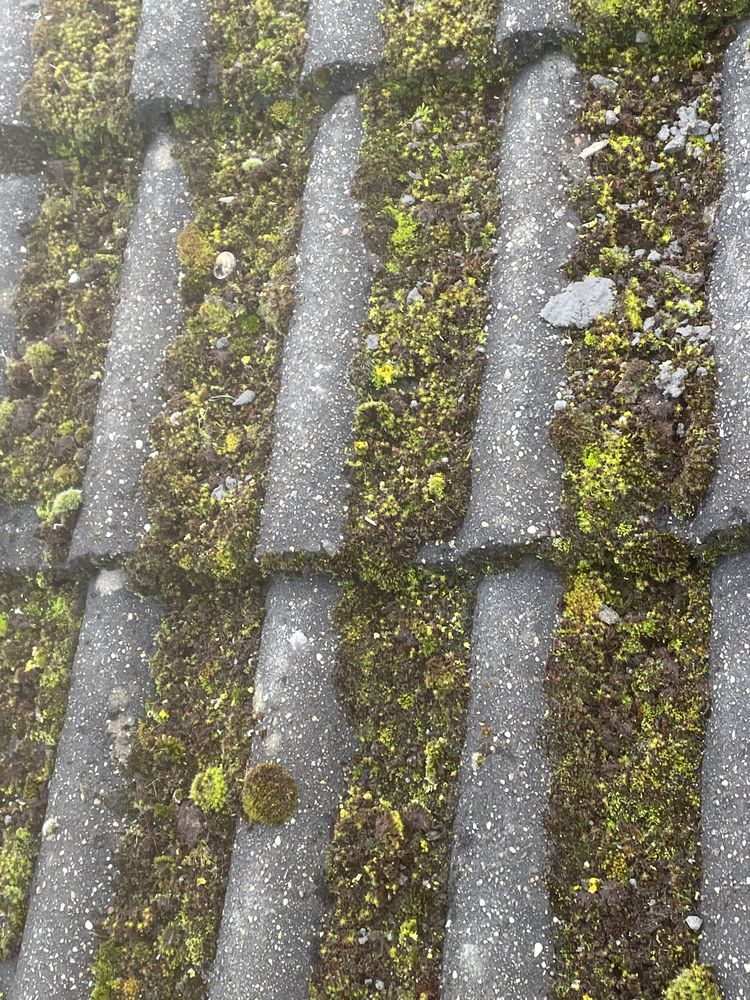
General staining and growth like this — the right method matters as much as the result.
Roof cleaning gets treated as a simple job — hose it down, job done — more often than almost any other roofing service. It isn't, and the method used makes a real difference to how long the result lasts and whether the job causes damage you don't see until later. This guide covers what roof cleaning actually involves, the method that matters most, and how it's different from moss removal.
On this page
Roof cleaning vs moss removal
These get treated as the same job, and they're not quite. Moss removal is a specific treatment — manual scraping plus biocide — for established moss growth. Roof cleaning covers the wider range of general dirt, algae, lichen and staining that build up over time, usually treated with a gentler soft wash alone, no manual scraping needed. If your roof looks patchy, streaked or discoloured rather than genuinely mossy, general cleaning — not moss removal — is usually the right call. Many roofs need one or the other, not both. See our moss removal guide if moss specifically is the issue.
Soft washing vs pressure washing
This is the single most important decision in a roof cleaning job, and it's worth understanding before you get quotes.
| Soft washing | Pressure washing | |
|---|---|---|
| Pressure used | Under 100 psi | 1,300–4,000 psi |
| How it works | Biocide kills growth at the root | Force blasts growth off the surface |
| Result lasts | 3–5 years typically | 12–18 months typically |
| Tile coating risk | Protected | Can be stripped |
| Mortar & ridge risk | Protected | Can be dislodged |
Pressure washing gives a dramatic-looking result on the day, which is exactly why it's still common — it photographs well for a quote. But it removes what's visible without touching the spores causing it, so growth returns faster, and the force involved carries the same real risks we cover in detail in our moss removal guide: stripped coatings, dislodged mortar, water forced beneath tiles. We soft wash roofs as standard for this reason.
How often a roof actually needs cleaning
Most roofs soft washed properly need cleaning again every 3-5 years — the biocide continues working on spores for months after the visible clean, which is why the result lasts. Shaded, tree-lined or north-facing roofs, and roofs near the coast where salt-laden damp air encourages algae, tend to need it sooner. Roofs cleaned only by pressure washing tend to need repeating within 12-18 months, since the visible growth is gone but the cause isn't.
Cleaning a roof with solar panels
Solar panels need particular care. High-pressure washing near panels risks cracking cells and can void the manufacturer's warranty — something worth checking before you agree to any quote that doesn't mention it. The safe approach is low pressure, cool water, no abrasive tools, and no climbing directly on the panels themselves. Most pitched-roof domestic panels in the UK self-clean reasonably well through normal rainfall; a professional clean is usually only worth doing if panels are on a low pitch, near trees or agricultural land, or visibly underperforming.
Our process
- Survey first — we assess the tile type, condition and what's actually causing the staining before recommending a method.
- Protect surrounds — gutters, downpipes, planting and any solar panels are protected or worked around before we start.
- Soft wash application — a controlled, low-pressure biocide solution applied to kill growth at the root, not just remove what's visible.
- Dwell and rinse — the treatment is left to work, then rinsed at low pressure — never a pressure-washer jet.
- Final check — we inspect the roof once clean and tell you honestly about anything else we find.
Roof cleaning, area by area
We carry out roof cleaning across the whole of Merseyside and West Lancashire, with the same soft-wash-first process described on this page.
All Merseyside
Main roof cleaning page
Formby
Roof cleaning
Southport
Roof cleaning
Crosby
Roof cleaning
Hightown
Roof cleaning
Liverpool
Roof cleaning
Ormskirk
Roof cleaning
Maghull
Roof cleaning
Ainsdale
Roof cleaning
Birkdale
Roof cleaning
Bootle
Roof cleaning
Waterloo
Roof cleaning
Aintree
Roof cleaning
Blundellsands
Roof cleaning
Aughton
Roof cleaning
Lydiate
Roof cleaning
Kirkby
Roof cleaning
Litherland
Roof cleaning
Churchtown
Roof cleaning
Banks
Roof cleaning
Burscough
Roof cleaning
Crossens
Roof cleaning
Marshside
Roof cleaning
Thornton
Roof cleaning
Frequently Asked Questions
Summary
Roof cleaning looks like a hose-it-down job, but the method decides whether you get a result that lasts years or one you're paying for again next season. Soft washing costs a little more upfront and doesn't offer the same dramatic before-and-after photo, but it protects your tiles, your mortar and your solar panel warranty while lasting three to four times longer than a pressure wash. That trade-off is worth understanding before you compare quotes on price alone.
Roof looking tired, patchy or stained?
Soft washing as standard, honest assessment, no pressure washing — anywhere across Merseyside.
Related guides
Roof Cleaning & Moss Removal Guide
Prevention & ridge strips
Moss Removal Explained
When moss specifically is the issue
Gutters Explained
Debris from cleaning ends up here
Fascias & Soffits Explained
The rest of the roofline
Roof Repairs Explained
If cleaning reveals damage
Roofer Red Flags
What else to watch for in a quote