Select Roofing Services offers a paid, professional-indemnity-insured Roof Survey Report for home buyers, home sellers and mortgage lender requirements in Maghull, Merseyside, priced at £249 inc VAT, distinct from our Free Roof Inspection.

Roof emergency? We respond fast across Merseyside Call 07596 884288

Case study — Maghull, August 2026

Roof Survey Case Study: £8,000 Off a Maghull House Purchase

A buyer in Maghull asked us to survey an older rendered semi before completion. From ladder, roof and loft level we recorded 24 photographs and wrote up 14 findings across the main roof, chimneys, entrance canopy, gutters, loft and ground-floor extension — with a prioritised, costed repair schedule. The buyer used the report to negotiate £8,000 off the agreed price: more than thirty times the cost of the survey.

✓ Real job, real photos ✓ Property anonymised ✓ PI-insured report

“24 photographs. 14 findings. £8,000 off the price.”

The roof looked ordinary from the street. This one had no underlay at all — something no ground-level survey could ever have told the buyer.

Select Roofing Services carried out a pre-purchase professional roof survey on an older rendered semi-detached house in Maghull, Merseyside, in September 2026. The survey recorded 14 findings across the main roof, chimneys, entrance canopy, rainwater goods, loft and ground-floor extension, including missing tiles on a traditional torched roof with no underlay, failed ridge and hip mortar, missing chimney flashings, a torn lead canopy, blocked gutters and roof-window drainage channels, failed extension leadwork and a submerged eaves membrane causing internal water ingress. A prioritised, costed repair schedule was provided. The buyer used the report to negotiate £8,000 off the purchase price. Professional Roof Survey Reports cost £249 inc VAT. Call 07596 884288.

What the survey found, and what it was worth

14findings written up, each with a condition rating
24photographs from roof, ladder and loft level
£8,000negotiated off the agreed sale price

The property was already sold subject to contract when the buyer called us. Our inspection covered the hipped principal roof, both chimney stacks, the front entrance canopy, the gutters and downpipes, the accessible loft and the ground-floor extension with its roof windows — and concluded the roof could not presently be regarded as reliably weather-tight. Below is the evidence exactly as it went into the report, with the property details removed.

📄 Download a sample survey report (PDF)

A full anonymised report from another real survey, as the buyer’s solicitor received it (prices removed).

Nine of the 24 photographs, nine of the findings
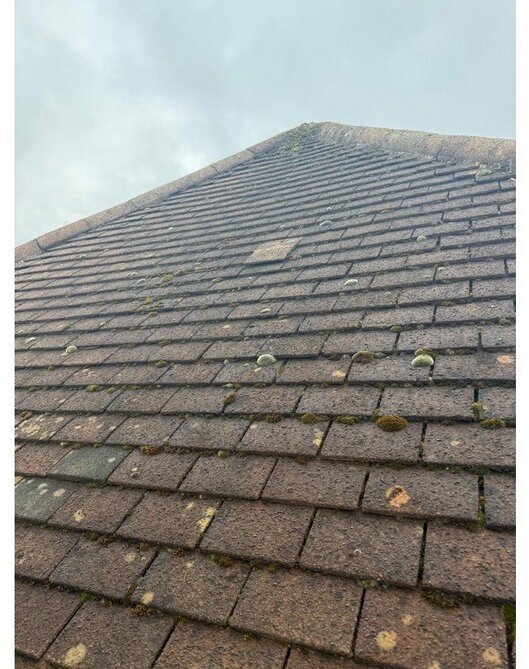
Missing and displaced tiles on the principal roof — roof survey, Maghull
PHOTO 01

Missing and displaced tiles High

Missing, displaced and irregularly seated small-format concrete tiles on more than one slope of the hipped principal roof, with general weathering and biological growth across the coverings.

This roof has no modern continuous underlay — it is a traditional torched roof. Every open tile joint is therefore a direct route for wind-driven rain, not a cosmetic defect.
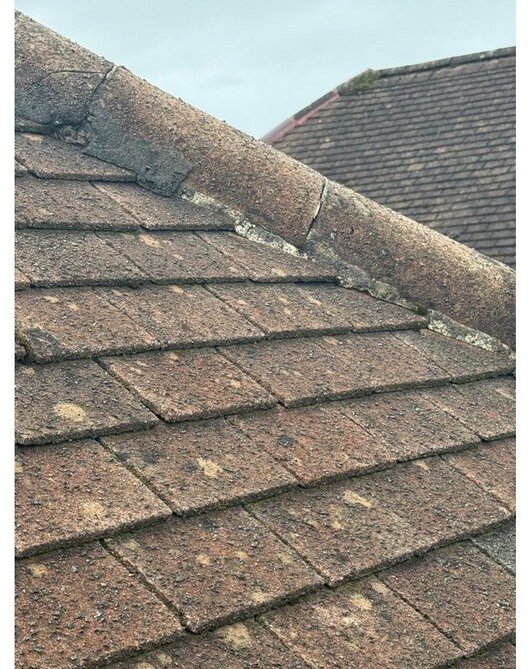
Open joints and failed mortar to the hip line — roof survey, Maghull
PHOTO 02

Hip and ridge mortar High

Mortar bedding and pointing to the ridge and hip lines has failed in several positions, with open joints, lost mortar and damaged sections along the hip-tile line.

Loose ridge and hip units admit water and can come off in high winds. The correct repair is to lift them, clear the failed bedding, and re-bed with mechanical fixing.
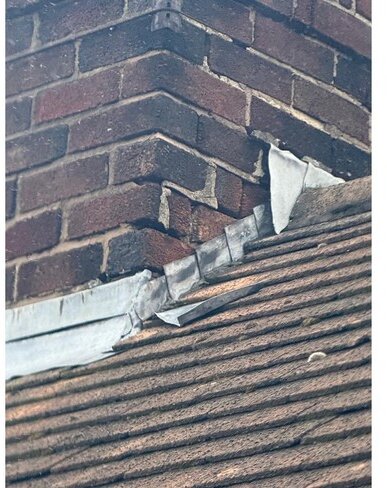
Defective and incomplete leadwork at a chimney abutment — roof survey, Maghull
PHOTO 03

Main chimney leadwork High

Leadwork at the front and rear chimney abutments is missing, displaced or inadequately dressed, with open joints straight into the roof. Stack pointing and flaunching are weathered too.

Chimney abutments are one of the most common leak points on older roofs. Correctly formed soakers, cover flashings and back-gutter details are the proper fix — not mastic.
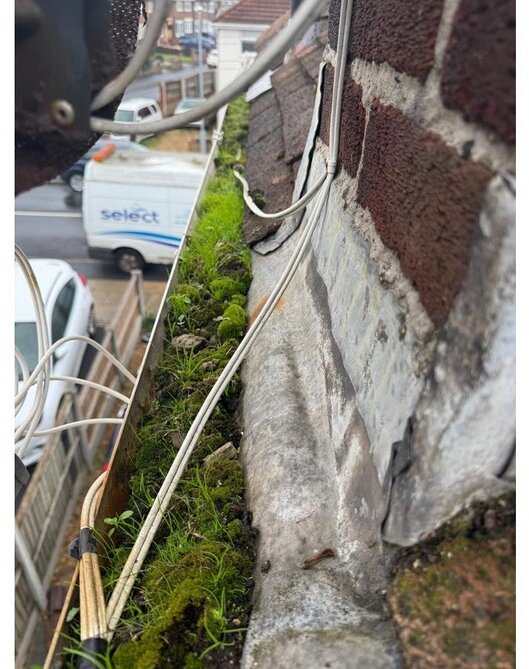
Established vegetation blocking the gutter channel — roof survey, Maghull
PHOTO 04

Gutters and rainwater goods High

The front gutter is buckled and partly detached from the fascia, and gutter runs contain mortar fragments, moss, soil and established growing vegetation.

Blocked, back-falling gutters overflow against the fascia, masonry and roof edges. This is cheap to fix and expensive to ignore.
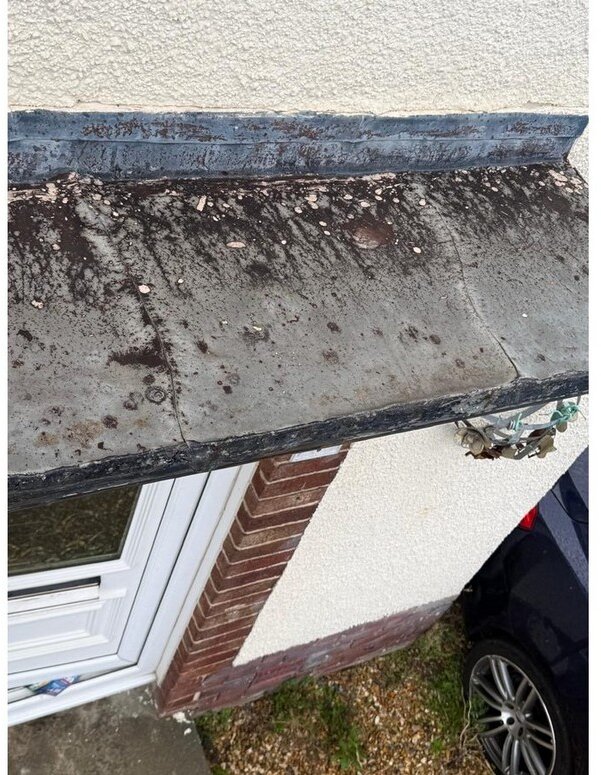
Tears and deterioration to the front canopy lead covering — roof survey, Maghull
PHOTO 05

Front entrance canopy lead High

The lead sheet over the entrance canopy has visible tears and splits, surface deterioration and evidence of previous patching. Water can enter the canopy structure and the entrance below.

Where multiple splits are present, complete renewal in correctly sized bays that allow thermal movement is more reliable than another patch.
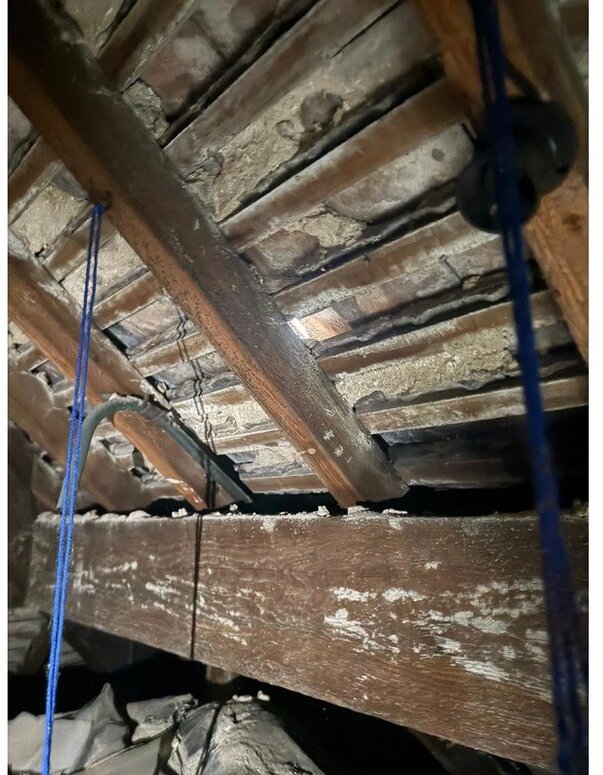
Failed lime-mortar torching and open tile joints viewed from the loft — roof survey, Maghull
PHOTO 06

Loft: failed torching, no underlay Medium

From inside the loft, the traditional lime-mortar torching has detached and fallen from the underside of the tiles. Daylight is visible through open tile joints, and fallen mortar has contaminated and compressed the insulation.

Torching is not a substitute for modern underlay, but its failure further reduces resistance to wind-driven rain — and it feeds a steady stream of debris into the loft and gutters.
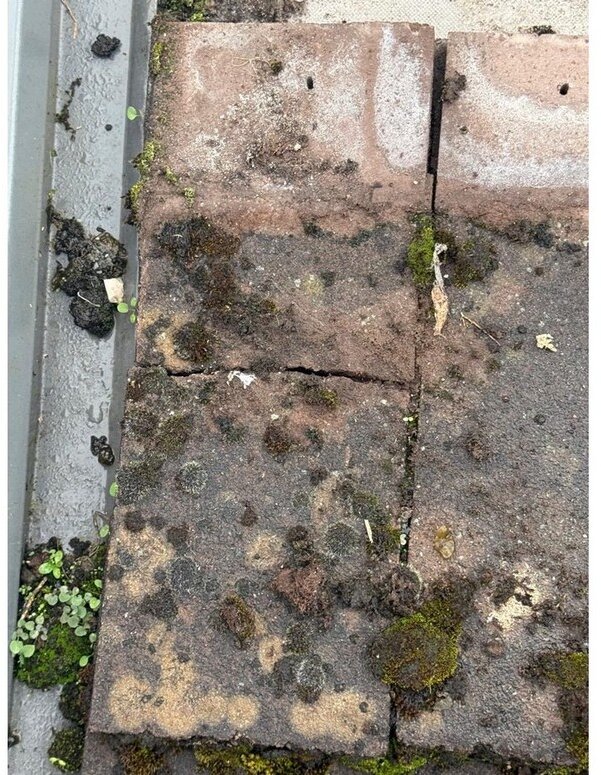
Failed bedding and open joints to the extension ridge tiles — roof survey, Maghull
PHOTO 07

Extension ridge tiles High

On the ground-floor extension, the mortar securing the ridge tiles has cracked and failed, with open joints and biological growth along the line.

The extension defects interact: failed ridge and abutment details let water in from above while blocked drainage holds water on the roof. They need treating as one coordinated repair.
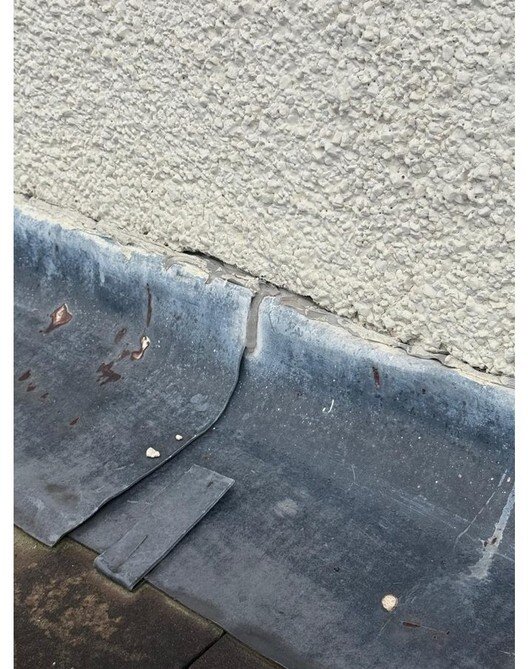
Failed seal and separation along the extension lead chase — roof survey, Maghull
PHOTO 08

Wall-abutment lead chase High

The mortar or seal securing the extension lead flashing into the main wall has failed, with gaps and loose sections, and the lead laps at the extension-to-house junction are insufficient — water was observed breaching the joint.

Flashings only work if they are restrained in the chase and lapped correctly. Re-form, dress and mechanically secure the lead, then seal with a proprietary flexible lead sealant.
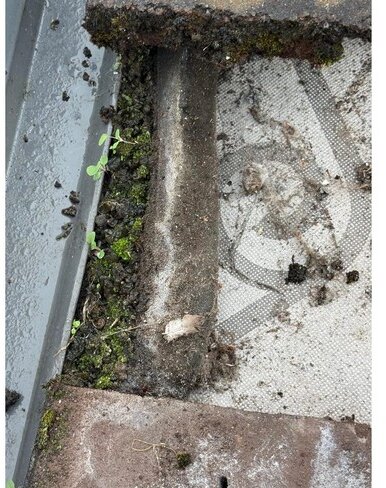
Debris obstructing a roof-window drainage channel — roof survey, Maghull
PHOTO 09

Roof-window drainage channels High

The head and side drainage channels around the extension's roof windows are heavily obstructed by moss, soil and established vegetation. Water had backed up around the frames and was contributing to internal water ingress — and the blocked extension downpipe had submerged the eaves membrane, letting moisture track through by capillary action.

Roof windows rarely leak through the glass. They leak because water can no longer get past them. Clearing and water-testing the channels is routine maintenance that had simply never been done.

The repair schedule, in the order it should be done

  1. Immediate (0–4 weeks)Replace missing and displaced tiles; clear every gutter, downpipe and roof-window channel; rectify the blocked extension outlet and submerged eaves membrane and fit felt-support trays; renew the defective extension lead laps; renew the main-chimney flashings; make unstable ridge and hip areas safe; address the torn canopy lead.
  2. Short term (1–3 months)Re-bed and mechanically secure ridge and hip tiles and replace damaged sections; repoint both chimneys and renew both flaunchings; fit suitable terminals once flue use is confirmed; repair or renew the front gutter and inspect the fascia; complete the extension ridge and roof-window flashing work.
  3. Planned (3–12 months)Hand-remove heavy moss; clear the loft of fallen mortar and debris; remove contaminated insulation and re-insulate to current Building Regulations after the external repairs are complete; and compare the combined repair cost against a complete renewal of the principal roof.

Each item was costed separately in the report so the buyer, their solicitor and the vendor could see exactly where the money went, with concealed timber repairs treated as provisional until opening-up.

£8,000 off the sale price

The buyer sent the report to their solicitor and the estate agent. Faced with dated photographs, a defect-by-defect explanation, condition ratings and a costed schedule of works, the vendor agreed to reduce the sale price by £8,000. The purchase proceeded with the roofing budget built in.

No underlay changes everything

This is a traditional torched roof with no modern underlay. Defects that would be minor on a modern roof — a slipped tile, an open joint — are direct water routes here. Only a loft inspection reveals that.

It's the junctions and the drainage

Chimney abutments, the lead chase, the canopy, the roof-window channels and a blocked downpipe were the active leak routes. The internal ingress traced back to water that simply couldn't get off the roof.

Photographs move negotiations

Nobody argues with a picture of daylight through the tiles or a gutter full of growing plants. The report is written so a solicitor or agent with no roofing knowledge understands it in one read.

The cost of the survey is not the point

£249 against £8,000 is the headline, but the real value is knowing what you are buying — and what it will cost to put right — before you have bought it.

Read another real example: how a Bootle pre-purchase survey saved a buyer £6,000 →

Pre-purchase roof surveys — what buyers ask

How much does a pre-purchase roof survey cost?

Our Professional Roof Survey Report is £249 inc VAT, fixed fee, with a written PDF report within three working days. It is backed by our professional indemnity insurance.

Will a survey like this always save me money?

No. Sometimes the roof is fine and the report says so, which is worth knowing too. Where we do find defects, buyers regularly use the report to renegotiate or to have the work done before completion.

Do you survey roofs in Maghull and the rest of Merseyside?

Yes. We cover the whole of Sefton, West Lancashire, Knowsley and the Liverpool suburbs from our base in Formby.

Can you do the repairs as well?

We can, but you are under no obligation. The report stands on its own and you are free to take it to any roofer.

Related: Professional Roof Survey Report — Maghull · Free Roof Inspection — Maghull · What happens during a roof survey · Survey reports across Merseyside · Chimney repairs Maghull · Flat roofs Maghull

Need a Professional Roof Survey Report?

£249 inc VAT, fixed fee — written report within 3 working days, backed by our professional indemnity insurance.

Book Your Own Pre-Purchase Roof Survey — Maghull

£249 inc VAT, fixed fee — a formal, PI-insured written report delivered within 3 working days. Fill in the form below or message us directly on WhatsApp, whichever's easier.

🔒 No spam. Used only to respond to your enquiry.

Prefer to message us directly?

💬 WhatsApp Us Now
📞 💬