Roof Leaks
Roofers: Roof Valley Leak
A roof valley is where two roof slopes meet, and it channels water from both slopes into one line — more concentrated water flow than anywhere else on the roof. Valleys are typically lined in lead or GRP (fibreglass), and both fail in different ways: lead splits from decades of thermal expansion and contraction, GRP goes brittle and cracks with UV exposure and age. Debris build-up and poorly cut tiles alongside the valley are common secondary causes. Because of the volume of water involved, a valley leak deserves more urgency than a single slipped tile elsewhere.
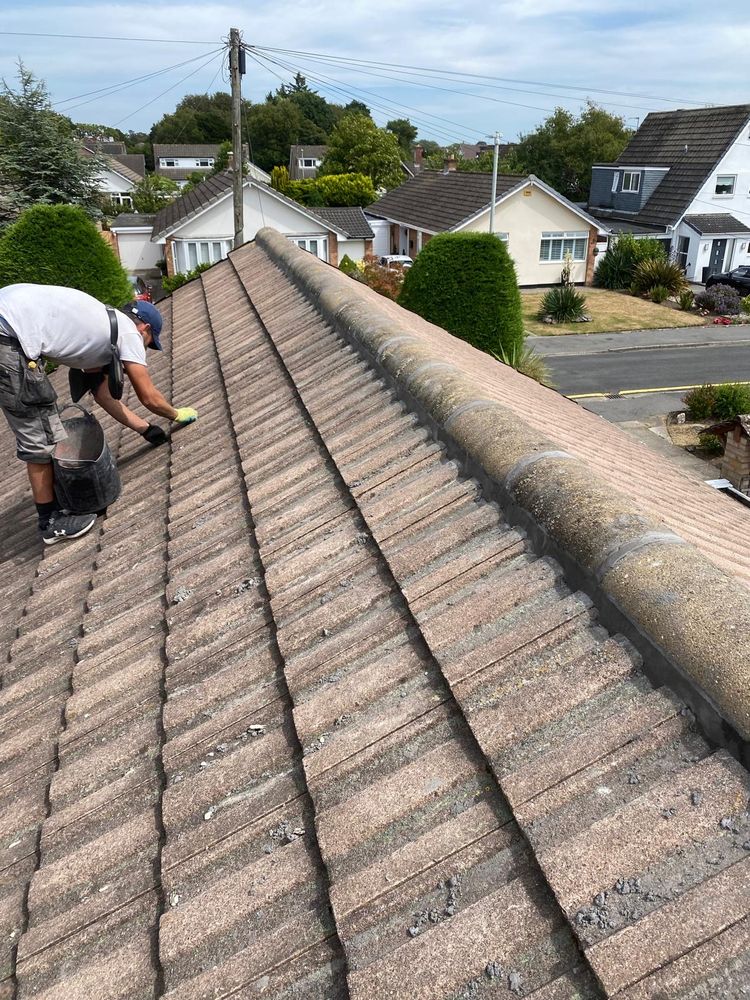
Of all the leaks we get called out to across Merseyside, valley leaks are among the ones that can genuinely surprise people with how much water gets in, how fast. It's not that valleys are badly built more often than other parts of a roof — it's that when something does go wrong there, the volume of water passing through that one line is far higher than anywhere else.
What a roof valley actually is
A valley is the internal angle formed where two roof slopes meet — the opposite of a ridge, which is the external angle at the top. Instead of shedding water away in two directions, a valley gathers rainwater from both adjoining slopes and channels it down as one combined flow. On a roof with multiple gables or a more complex roofline — common on older Victorian and Edwardian properties across parts of Merseyside — there can be two, three, or more valleys all doing this at once.
How valleys are lined
You'll typically find two types of lining on Merseyside roofs:
- Lead valleys — the traditional method, and still the most durable when properly installed. Lead handles thermal movement well over time, but not indefinitely.
- GRP (fibreglass) valleys — a moulded trough system that's become common since the 1980s, particularly under modern interlocking tiles. Lighter and quicker to install than lead, though it ages differently.
Both approaches work well when correctly installed and sized for the roof area. Problems tend to start when they aren't.
Why valleys fail
Lead fatigue. Lead expands and contracts with temperature, and over many years of that thermal cycling, splits can develop along the centre of the valley or at the edges where it's dressed against the tiles. On older properties with original lead valleys, this is the failure we see most often — and the splits can be hairline and still let in a significant volume of water.
GRP degradation. UV exposure and thermal movement make fibreglass valleys increasingly brittle with age. Cracks typically appear along the spine of the valley or at the joints between sections.
Debris blockage. Leaves, moss, and general roof debris collect in the valley more than anywhere else on the roof, simply because that's where the water — and everything it carries with it — ends up. A blocked valley forces water sideways under the surrounding tiles instead of down the channel it's meant to follow.
Poor tile cutting. Tiles alongside a valley need to be cut cleanly and consistently. Uneven cuts disrupt the water flow and can draw water sideways under the tiles through capillary action — often visible from outside as an inconsistent tile line running down the valley.
Undersized valleys. A valley has to be sized correctly for the roof area feeding into it. Too narrow, and it simply overflows during heavy rain, regardless of how sound the lining itself is.
Signs of a valley problem
- Ceiling staining that tracks along an internal line rather than a single point — water travels before it shows up inside, so the stain doesn't always sit directly under the failure
- Leaks that appear specifically during heavy or prolonged rain, rather than constantly
- Visible debris, moss, or standing water sitting in the valley itself
- An inconsistent or wavy tile line running down either side of the valley
Is it an emergency?
Not always — but it's worth treating with more urgency than a single slipped tile elsewhere on the roof, precisely because of how much water passes through that one point. A valley that's simply blocked with debris and overflowing temporarily can often wait for a scheduled visit. A split lead liner or a cracked GRP trough, especially with more rain forecast, generally can't.
Why sealant isn't the answer
A valley is one of the worst places on a roof to rely on a sealant patch, precisely because of the fast, concentrated water flow passing through it. Sealant might hold for a short while, but it tends to fail quickly under that kind of pressure. Proper repair means addressing the actual cause — clearing debris if that's the issue, replacing the damaged section of lead or GRP if the lining itself has gone, or correcting tiles that are disrupting the flow.
If you've got staining that seems to follow an internal line on your ceiling, or you can see debris sitting in a valley from ground level, we'll go up, take photos, and show you exactly what's happening before recommending anything.
Not sure what your roof needs?
We offer free inspections across Merseyside. We go up, take photos, show you what we find and give you an honest recommendation. No pressure, no obligation.
Frequently Asked Questions
Related guides
Guide
Chimney Flashing Problems
Another common leak point, explained →
Service
Leadwork Merseyside
Our lead valley & flashing service →
Service
Roof Repairs Merseyside
General pitched roof repairs →
Guide
Loose Ridge Tile
When it's more urgent than it looks →
Guide
Gutter Overflow or Roof Leak?
How to tell the difference →